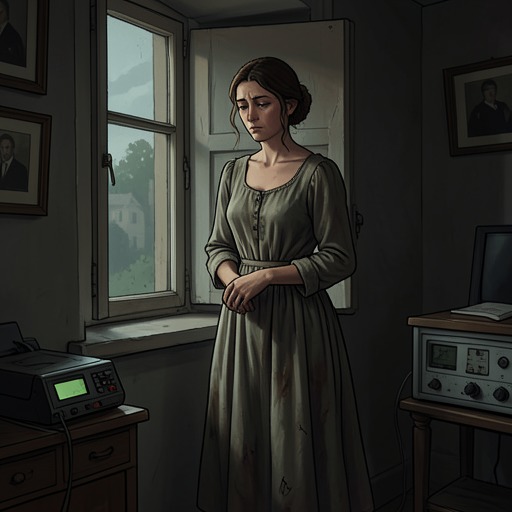
Janet Sweet
Anne of the IslandJanet Sweet is the warm-hearted landlady at Wayside whose long, unspoken courtship with John Douglas gives a domestic episode in Anne Shirley’s life its emotional force. At forty, she has spent two decades waiting for John to ask her to marry him, while concealing both her disappointment and the reason she thinks others might judge her. The revelation that his silence came from a promise to his dying mother turns what looked like rejection into a painful act of filial duty—and gives Janet the chance to choose forgiveness over public vindication.
Identity and First Impression
Anne Shirley introduces Janet in a letter to Philippa Gordon after taking a teaching post at Valley Road and boarding at Wayside. Janet is tall and stoutish, with soft, crimped brown hair threaded with gray, rosy cheeks, and blue eyes. Anne also notes her generous cooking: Janet is willing to serve rich feasts even if they do little for her lodger’s digestion. The portrait makes practical kindness part of her presence; hospitality is not an abstraction but something she offers at the table.
Janet likes Anne partly because she once had a sister named Anne who died young. When they meet, Janet expects her new lodger to resemble that sister, who was dark-haired, and is surprised to find Anne redheaded. Anne briefly worries that the blunt comment will sour her first impression of Janet, then checks her own prejudice: Janet may simply lack the word auburn. The moment establishes a small but telling pattern in their relationship. Janet speaks plainly, while Anne makes an effort to understand her generously.
Life at Wayside
Janet’s inner life becomes visible through her ordinary routines and her attachment to John. On Anne’s first Thursday in Valley Road, Janet dresses up for prayer meeting in a pale-blue muslin covered with pansies and ruffles, topped with a white leghorn hat decorated with pink roses and three ostrich feathers. The narrator presents the display as more lavish than Anne expects from economical Janet and hints that it has a romantic purpose. At the meeting, Anne notices a solitary man among the women and boys: ungainly, long-legged, stooped, and untidily groomed, yet kind-looking and tender-faced. His expression suggests someone who has suffered and endured with patience and humor. The scene places Janet’s quiet romantic hope amid the everyday social life of the community.
That hope surfaces three days later, when Anne returns from school to find Janet crying. Janet explains that it is her fortieth birthday and that John Douglas still has not asked her to marry him. Her distress is not a sudden disappointment but the breaking point of a secret she has never told anyone. She says that John began visiting her twenty years earlier, before her mother died, and simply kept coming. During those years Janet made quilts and other things, but he never spoke of marriage. After her mother’s death, she thought he might finally propose because she had been left alone; instead, he remained kind and attentive without asking.
A Courtship Held in Silence
Janet has endured not only uncertainty but the humiliation of being misunderstood. People assume she will not marry John because his mother is sickly and Janet does not want the burden of caring for her. Janet says the opposite is true: she would be glad to look after John’s mother. She has allowed the community to blame her rather than pity her, because she finds it dreadful to have others pity her for a proposal that never came. The explanation reveals how carefully she has protected both her privacy and John’s reputation, even as the silence leaves her unable to understand what is keeping them apart.
The household’s circumstances make that silence consequential. John is anxious about leaving home because his mother suffers severe spells and might become ill while no one but the hired girl is there. Janet is aware of his responsibility and is willing to share it, but she does not know that his hesitation comes from a promise rather than a lack of affection. When Anne wonders whether John’s mother might oppose his marrying, she comes close to the truth without yet knowing its history. Janet’s patience has been shaped by an explanation kept from her, not by any settled choice to wait without question.
The Promise and the Resolution
John eventually explains that nineteen years earlier his mother had suffered a grave attack. Everyone expected her to die within six months, and she implored him, on her knees, not to ask Janet to marry him while she was alive. He did not want to make the promise, but he did so because she was sick and suffering. The request accounts for almost the entire period of John’s silence: the decision that controlled Janet’s future was made in a moment of family crisis, without Janet’s knowledge, and preserved as a secret for years.
When John finally speaks, Janet asks why he did not tell her sooner. Once she knows the reason, she says she is happy at last and would not have minded waiting so long if she had understood why. They plan a quiet wedding for the following month. John wants to make the truth known, but Janet persuades him not to expose his mother’s request or let the community condemn her after death. She accepts that people may say she hurried to marry John as soon as his mother was gone, and insists that the secret be buried with the dead. Her decision gives precedence to the memory of a deceased woman over Janet’s chance to correct the public story about herself.
Forgiveness and Narrative Significance
Anne is more angry on Janet’s behalf than Janet is: she tells her that she is more forgiving than Anne could be. Janet answers that forgiveness comes more easily at forty than at twenty, presenting age not as mere endurance but as a source of changed judgment. The response does not erase the cost of the wait. Rather, it shows Janet deciding that the truth of John’s promise matters more to her than vindication before neighbors who have misunderstood her.
Janet’s story is told through Anne’s experience of living at Wayside and hearing a confidence offered at a moment of distress. Its movement is from an apparently simple fact—John has visited for twenty years without proposing—to the hidden promise that recasts those years. Janet is neither merely a patient sweetheart nor simply the object of John’s eventual choice: she has borne the social consequences of their silence, remained willing to care for his mother, and, once the truth is known, actively determines how the story will be remembered. Her ending is a marriage, but the decisive change is that uncertainty gives way to knowledge and she can finally choose, with full awareness, to forgive.